
Do you speak with your true voice?

“But expression is more than just mouthing the words. It is the exchange of what matters between living things.” Mark Nepo

The other day, I was speaking to someone who had a few colds over winter that had developed into laryngitis. After she lost her voice again, she sheepishly admitted to me that she had decided to refer to her Louise Hay book “You Can Heal Your Life”. Looking up laryngitis she found under probable cause “So mad you can’t speak. Fear of speaking up. Resentment of authority.”

I asked her if this felt true to her. Her answer was ‘Oh, definitely. I can see how that is true for me, particularly at work.’ I remembered similar stories from people I have known, especially as a stress consultant. Not just people who found they were regularly losing their voices but others who felt reluctant to speak up or to express their feelings in certain situations.

I realised that this was an important component of something I had been thinking about and researching. Coincidence? Well, more an example of “what you focus on expands” but it certainly got my attention.

I had been researching the idea of finding your voice. More specifically about finding your authentic voice, the voice that truly reflects who you are, beyond the petty needs and worries of your small self/ego.

For the person I was speaking to, it was more about having a voice but the connection was clear and added a new dimension. After all, to have a voice, first you need to find it. On reflection, I remembered situations where I felt unable to speak up. So, I am interested in the reasons so many people find themselves in situations where they do not or cannot express what they are feeling or thinking. This is important to understand because it creates stress inside you.

However, finding your authentic voice is not just about being able to speak. There are plenty of people who have no trouble speaking out but I do not believe that they are always speaking with their true voice. There have been times for me, and I know for others, when what I have said or how I have said it does not reflect who I truly am or what really matters to me. What does this mean? Finding and speaking with your authentic voice is about connecting, about expressing who you truly are and what really matters to you.

Without that, you experience disappointment and discomfort as well as stress. In the end, speaking with a true voice, “exchanging what matters”, impacts on all of our relationships.

I intend to expand on this further but right now, I would like to invite you to notice when you are speaking with your true voice and when you are not, and how that feels. Please add a comment or email me with any thoughts you would like to share.

Are women really better at relationships?

At the end of my last blog, I said that I would write about why women tend to be better at relationships than men. This seemed an appropriate thing to talk about because I am teaching a workshop on the 9th August.

It is a workshop for women, called Free Yourself and Connect: A Whole of Life Approach to Improving Relationships. You can read more about it here.

I’ll be honest; at the time I worded it that way because I wanted to catch your attention and, perhaps, trigger some thought on it. I suspect, that many women, because of their own experience, might agree. However, trying to categorise human beings is always tricky, because each individual is unique. So, if you ask is this true; it is always a “maybe yes, maybe no”/”it depends” answer. This is why I used the word ‘tend’.

Relationships are at the very core of who we are and how we live our lives but many of you may have observed that men and women look at relationships and the world differently.

Let me give you an example. A group of young mothers with their babies and toddlers meet for an exercise class in the park opposite our house once a week. They get into a circle and there is a lot of discussion and chatting as they go through some gentle movement and stretches. My son was visiting me on a day when they were in the park and he observed them as we sat on the veranda drinking our coffee. Finally, unimpressed with the intensity of their exercising, he asked, “What are they doing?”

This difference is best understood by looking through the lens of the feminine and masculine traits or types rather than comparing males and females. Feminine and masculine traits exist in both men and women but present differently in each individual. There are many factors that contribute to this, much like the different personality types in eagles cropped 2the Enneagram. The unique presentation of the masculine and feminine within any personality type contributes to each person’s individuality.

It is important to understand that both masculine and feminine traits have value depending on what is needed at the time. It is a difference in orientation in the way in which we relate to ourselves, with each other and with the world around us.

As a general overview, Masculine traits or type are more oriented towards doing and having control over the external world. So this includes:

  • A results/goal and solution orientation with emphasis on doing rather than being and feeling
  • Autonomy – a desire to act without interference
  • Independence – attempting to act free from influence

Whereas, relating, connecting with and nurturing others is the defining drive of the Feminine type and includes:

  • Strength through sharing and exchanging important thoughts, feelings and experiences
  • Interdependence – self-worth, influence and power, in many ways, is seen as coming from connection to others
  • Fullness and completeness is found in relationships, connection, emotional expression and feeling.

So my reply to my son was, “They are connecting. They are just choosing to be outside and move rather than to sit down inside while they are connecting.”

Although men tend to more easily access the masculine traits and women the feminine, we all can access both. There is a continuum of expression from the masculine to the feminine type in each of us. If not balanced and moderated, both types can tend towards unhealthy presentations and unhealthy relationships at either end of the spectrum.

For example, the masculine trait of results/goal orientation, if not balanced, can lead to the goal being the only thing that can be seen and being prepared to do anything to achieve that result including control and aggression. One outcome is that people can be hurt as their needs and desires are ignored or trampled on, another is war. The feminine trait of strength through relating and connecting becomes unhealthy when it leads to a fear of being alone and being unable to function outside of a relationship. One outcome is people who, despite a number of failed relationships, rush into the next one. Their fear makes them unable to stand back and take the time to understand what it is that keeps recreating this experience.

Try this: consider the masculine and feminine traits and get a sense of which traits you value and which you rely on and use in your own life.

When I first studied these different traits, I was surprised to realise that, for most of my life I had tended to rely on and value the masculine traits within myself, or more accurately, the masculine power system. This was a reflection of my personality and upbringing and Western culture including the feminist “I am woman hear me roar” movement of my youth. Although the feminine traits within me drove my mothering and my relationships, I did not value these in the same way. In fact, I did not understand their real value or power when developed in a healthy and balanced way.

To a large degree, most of the world functions within a masculine power system. The feminine traits have not been truly valued– not seen as equally important to develop as the drive for success, achievement and financial growth. There is much to be learnt and understood about the power and value of the feminine traits. Balance is needed.

The fact is that women do have an innate drive to relate and connect. I believe that it is important not only for ourselves but also for the future of our children that we discover ways of relating and connecting more skilfully, taking a Whole of Life perspective, in order to create a healthy and balanced way of functioning in our world.

We do have the capacity to make a difference directly and through a ripple effect:

  • With our families and in our homes
  • In our workplace
  • In our community and with our friends
  • In the world around us
  • To our children and our loved ones
  • To ourselves.

 “I alone cannot change the world, but I can cast a stone across the waters to create many ripples.” Mother Teresa

If anything has come up for you that you would like to share, leave a comment or send me a message.

Do your relationships create balance in your life?

Do you ever get to a point where you feel like you need more balance or more flow in your life? Most of us do, but the trick is to figure out what it is that is triggering that feeling. Without getting clear on that first, we can often end up doing things that are unsustainable or don’t actually make a difference. One of the reasons this happens is that we interpret the feeling as stress. My study and work as a stress consultant lead me to take a different perspective on understanding how to create balance and wholeness in our lives.

This is my story.

I learnt many things through my study and work as a stress consultant, including that relationships are a common cause of stress. Now, this is not exactly ground breaking information, but what was really interesting to me is how poorly equipped most of us are to skilfully navigate our way through difficult relationships or the difficulty of relationships.

As one of 4 siblings and a mother of 4 adult sons, the reality is, that even in a family (or maybe especially in a family!) there is always one relationship or another that could do with improving or enriching! Of course, this applies to any area of our lives. For over 20 years, I worked as a dietitian and nutritionist in both public and private hospitals and after I did my MBA, I worked as a CEO. I can honestly say that I experienced just about every type of work relationship in that time.

So, it’s not just in our families that we experience relationships (or situations around relationships) that can challenge or frustrate us, trigger stress or make us feel powerless, less valued or simply stuck.

For some, it leads to a deep-seated feeling of wanting to be free – but at the same time, not wanting to lose your connection to the people that matter to you.

For others, it leads to a desire for life to flow more easily. It is a desire for you to be in the flow, not working against or in spite of but flowing with the relationships or situation.

When you start looking for help, for more understanding, for tools and answers, you discover that there is an awful lot of information, books, websites, therapies and new age ideas out there. You need to be able to filter it all, find what is valid and valuable, discover how to apply it from a practical perspective and you need to dedicate the time to do the research. I used science and medicine as my filter and extended my study to Eastern wisdom traditions and healing as well as established modern theories and understandings, such as Integral Theory and the Enneagram.

As I worked with people, observing the effectiveness of the medical model, different therapies and theories, I came to an important conclusion. There is no one treatment, no one therapy or idea or concept or theory that by itself can take a person all the way to health and wholeness, to freedom and flow, to happiness and fulfilment. You need a science-based, integrative and balanced approach.

I set about bringing together the different areas of my research and my work. And I used the stresses and challenges in my life to learn, trial and grow my understanding. There was a time when we were hit by one tragedy or difficulty after the other. My research, my work and my learning and growth stood me in good stead not only to navigate my way through and support others but also to further grow my understanding.

I found I was slowly evolving and feeling a sense of freedom and flow. Those around me were experiencing the benefits ofmy increasing ability to access connectedness and inner wisdom, and to act more skilfully.

I was also beginning to see how to bring all of this together as a whole of life approach. Now, I want to share with you a part of what I teach.

The relationships that make up the Whole of your Life

The quality of our relationships determines everything – how you feel, what you are able to do, what you achieve and the ease, connection and happiness you have in your life. When I talk about improving relationships, everyone starts thinking about the relationships they have with people. However, these aren’t the only types of relationships that affect our lives. For example, we all have a some sort of relationship with food, which, like all other relationships, changes over time.

So, for your relationships to improve and enrich, you need to start thinking more broadly. We have distinctive perspectives or ways of looking at, relating with and experiencing the world. They are the parts that make up the whole of our life. Our relationships with the people and things that arise in those perspectives are interrelated and create a whole. Everything is connected, nothing happens in isolation.

Firstly, there is our relationship with other people in our lives. These include the relationship we have with those who are close and important as well as those who come and go in an ever-widening circle of contact and connection. These relationships give us a direct experience of community, connection and sharing. This is a fundamental need for everyone. You can make an enormous difference to someone’s day just by connecting with them. And yet we often don’t put our attention or energy into actively connecting with others.

Paddock with brahmansSecond, there is our relationship with the world around us. These relationships are important in many ways, especially to our health and wellbeing as well as our level of stress. They include our relationship with our environment (house/home, work, suburb), the natural world (trees, garden, pets, river, sea, forests), the systems in our society (health, banking, education, government) and our communication systems (internet, twitter, phone). Connection and connecting is key here as well.

Finally, the most fundamental of all our relationships is our relationship with ourselves. It is our primary relationship, the only one we are certain to have all of our lives. It is the only one we have total responsibility for. Only you have true access to your inner experience. Your relationship with yourself is complex and has a direct impact on all other relationships. It deserves your attention, time and energy and includes taking care of your inner experience, your body, mind, health, creativity and much more. The path to freeing yourself and deepening connections begins with improving and enriching this relationship. It is your path to choose and does not rely on other people doing things differently or circumstances changing before you can feel free.

Try this: Our attention tends to be on one area of these relationships more than the others. To make our life whole and to create balance, we need to enhance and improve the relationships in all areas. On a day-to-day basis, where does your attention, time and energy tend to go?

Before I sign off, there is something I’d like to leave you with.

Life is definitely a journey. I’ve learnt that there is no point in asking “am I there yet?” and being disappointed when something happens and I realise I am not. Life is like that. There will always be challenging situations and people. There will always be relationships that suddenly seem to “go wrong”. Anything and anyone in your life can trigger hurt, stress or frustration. But, if you know how, everythingin your life can be a source of learning and support. There is always more to learn. This is because there is always more in you and of you, than you could even begin to imagine when you first start out.

The other day I was talking to someone who has been living from the perspective of a Whole of Life Approach for a while now. I was telling her a story of a recent experience I had and said, “It was a good learning opportunity”. She interrupted, saying “ Oh yes, that’s what I used to call a problem or difficulty; then I learnt to call it a challenge and now I only have ‘learning opportunities’. I’m not saying things don’t hurt but no matter how uncomfortable it is, I just don’t worry so much, I know how to work my way through. And, you know, its still magical to me how – it just works.”

As you go along, you learn to navigate through the challenging times more skilfully.

If you have any comments or questions, please send me a message or make a comment here on my blog post.

Next time, I am going to talk about why women tend to be better at relationships than men. I’ll also announce the date and venue for my next workshop and a special offer for those who are interested in attending with a friend.

Are you willing to make mistakes?

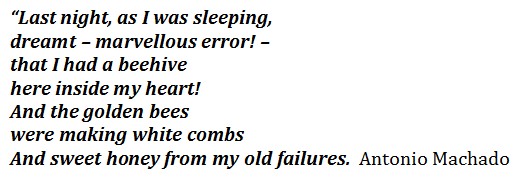
Poem


More accurately – Are you willing to make what appear to be mistakes, so that you can make corrections and learn?

This is the third in a series of posts that I have written about our wired-in tendencies to avoid feeling discomfort or stress. In my last post, “Do you take notice of coincidences?” I finished with an important quote from Albert Einstein “In the middle of difficulty lies opportunity”. I invited people to take the first step in discovering the hidden opportunity that lies in our stress, discomfort or difficulty. The first step was to start noticing what you do when you see difficulty or feel uncomfortable. I promised to follow up with another post.

I had people say to me that, as soon as they finished reading the second blog they wanted to read my next. I deliberately waited because, often, when we start noticing the hard-wired habits we have, it is enough. It can be both challenging and enlightening, and the learning and what needs to be done comes naturally or, with a little thought, is clear. So the heavy lifting can be in the first step.

However, the cursed “how” and “but” can get in the way and feed the avoidance habit. How can I feel better? How do I deal with this? But I have always run from difficulty. But it isn’t my fault so why should I be the one to do anything? Or whatever version fits the situation.

When I started thinking about what I should write, it became a bit like – how far down the rabbit hole do you want to go? It is a subject that links into so many areas, I could almost write a book. But that is not my purpose here. So I thought I would just offer some ideas for you to play with.

There are four steps that I would like to share with you. They stand up well against the examples I gave in my previous blog. They help deal with these hard-wired habits and the consequences that go with them. And you could find the hidden opportunity that lies in the middle of your difficulty, through any of these steps. They are clarity, courage, connection and correction.

Clarity

When we are in a reactive state, acting out or out of our hard-wired tendencies, wisdom has been taken out of the equation. You need wisdom to act skilfully. It is an internal state accessed when you move from a reactive, unconscious state of mind to one of conscious awareness. Wisdom needs clarity.

So difficult situations, difficult emotions always need clarity. What I’m talking about here is perspective and understanding. Do you understand what is really happening around you and in you? And, if other people are involved, do you understand their perspective as well? Clarity emerges as you begin understanding your needs and fears and theirs, responsibility and acceptance and much, much more than I can cover here.

Getting real perspective and understanding can be challenging because it can be hidden from us, we are not aware of them. It is hard to see what you can’t see. This is when we need someone to help.

If we are to find clarity and the opportunity in our difficulties we all need someone in our lives who speaks their truth without judgement. Someone who doesn’t just agree with us or rush to make us feel better. Yet at the same time, can measure when we need care and time to lick our wounds, and when we need to move – to wake up and grow up. It is called a growth relationship.

Courage

When we get really clear, we often find that what lies beneath these avoidance habits is fear. To take the next step we need to have courage. Courage should not be confused with “being brave”. Being brave often allows us to bypass clarity and avoid facing our fear and so bury it deeper where it can become even stronger.

Courage has a different hue. It is about working with your fear and moving forward skilfully. It is about understanding and taking responsibility for yourself and your actions.

Psychotherapist and author, Stephanie Dowrick, wrote about courage in her book “Forgiveness and Other Acts of Love”. She sums it up very well, “We long for a trouble-free Eden, for ourselves and even more for our children. But they will learn courage after they leave Eden, not before, and they will learn it through their engagement with living, not through avoidance”.

Connection

This is a crucial seal on beachcomponent in moving forward skilfully. Connection is a primary and core need of every human being. Where a connection exists, there is a relationship. Yet we pay little conscious attention to actively connecting with other people or the world around us, let alone with ourselves.

It is probably best explained using examples. First of all let’s look at keeping an honest, caring connection with ourselves. In the case of ‘pushing into the discomfort of exercise’, which I wrote about in my first blog, this type of connection means we can trust ourselves to go that bit further and get the advantage of the exercise without pulling back or going too far. In the case of ‘avoiding the discomfort of taking ownership of our responsibility’, connecting with that part of ourselves that sees but does not judge, allows us to move beyond the discomfort, to act with courage and to heal.

If we look at situations that include other people, such as avoiding difficult discussions, there are two ways to create connection. One is externally, with honesty and care, finding a way that a connection can be established before we have the discussion. The other is internal, subtler and requires more skill. Briefly, it involves engaging your heart and mind in an energetic connection with the other person, beyond your and their ego-based defences. It may seem a bit odd, but it never ceases to amaze me how powerful this can be.

Correction

When we stop avoiding and start taking action, even if we act skilfully, we are exposed to a level of uncertainty, especially when other people are involved. It is why clarity, courage and connection are such important steps. And, in order to make corrections, they may need to be revisited.


Are you willing to make corrections as you go along (make mistakes and then correct)?

If you are, then the rewards (especially emotionally and mentally) can be really significant.

If you tell me you understand, I feel a little pessimistic. If you tell me you do not understand, I feel a little more optimistic” Thich Nhat Hanh

Every time I have to make corrections, I actually understand a little more.

Let me know how you go!

Do you take notice of coincidences?

“In the middle of difficulty lies opportunity” Albert Einstein

Do you take notice of coincidences when they appear in your life? I tend to because I have found there is always something of benefit waiting (wanting?) to be found.

My last blog was called “What do you do when you are uncomfortable?” It was about how, in some areas of our lives, we tend to avoid feeling discomfort or stress whether it is in exercise, situations or relationships. It pointed to the benefit of facing, pushing into and learning from the discomfort, stress or pain before choosing what action to take.

Within a few weeks of writing that blog, I experienced two completely different events that brought this tendency we have to avoid or minimise back into the forefront of my mind.

First, I observed a dramatic example of someone avoiding difficult emotions, both their own and other’s. It was uncomfortable for everyone and a situation that needed to be worked through but this person literally ran away.

Then, I received a blog written by Dr Ginny Whitelaw, a leadership expert and Zen Master, called “Taking Ownership: How we avoid it and How Zen tackles avoidance”. She was writing from a different perspective, focusing on leadership and global issues, and giving examples of how managers and leaders avoid situations that are or might be uncomfortable. But it was the same theme and the truth is, in our personal lives we are all offered opportunities to show leadership simply by the choices we make when faced with stressful situations, relationships, or even as we exercise. She wrote, “The problem with avoidance is that the problem doesn’t go away. Indeed, these wired-in tendencies to make easy choices have consequences –“

Were these 2 events coincidences that were worth taking notice of? I thought about what meaning I wanted to make of them. Was there more for me to learn about how I avoided discomfort or stress, or was it about expanding my writing and teaching around this? Both, I decided. I have found that learning and teaching are on the same trajectory – one is always informing the other.

The point is we all have “these wired-in tendencies”. In some way, big or small, in some aspect of our lives we make choices that try to minimise or avoid our discomfort or stress. It is a defence mechanism, designed to protect us from discomfort or pain, triggered when we perceive difficulty, stress or danger.2 birds

The more I thought about it, the more I began to recognise these hard-wired habits, in myself and in others. These are just a few examples that I noticed: putting off what could be a difficult discussion; automatically denying and pushing down any anger or upset when asked if you are okay; hitting out with hurtful statements; avoiding the discomfort of taking ownership of one’s own part in a situation by blaming others or talking endlessly about our “rightness”; putting off exercising or improving a diet; engaging in “retail therapy”; putting off changing that job or finding a new one; and taking the easy choices instead of doing the more difficult things to reduce energy usage, carbon emissions or waste.

Two things became clear. Firstly, these tendencies do have consequences, either directly or indirectly, on all of our relationships. They impact on our relationship with ourselves, with other people and with the world around us. They can lead to misunderstandings and disconnection. Secondly, awareness is the first step. Sometimes we know we are making these choices but cannot help ourselves or aren’t aware that there will be consequences. More often, we do not stop to see that we even had a choice.

Albert Einstein believed that “In the middle of difficulty lies opportunity”. Without naming and facing these tendencies, we can’t begin to see the hidden opportunity that lies in our stress, discomfort or difficulty. That is what I will write about next. For now, see this as an invitation to take the first step. Just begin by noticing what you do when you see difficulty or when you start to feel uncomfortable.


What do you do when you feel uncomfortable?

“The difference between what we do and what we are capable of doing would suffice to solve most of the world’s problem.” Mahatma Ghandi

When I was at a Pilates class recently, the physiotherapist told me to keep going until the muscles I was working on fatigued. Over the years I have trained with fitness trainers and I was familiar with the “no pain no gain” approach, so I pushed until the muscles stung and quivered. There is always this light-hearted banter in our group about what a hard taskmaster she is. To be fair, she explained that it was at that point of fatigue or “stress” that the most benefit was gained. The quote from Ghandi came to my mind and triggered some thinking about our general tendency to avoid discomfort and stress.

I was discussing this with a fitness trainer and he commented that, the reluctance to push until fatigued was the reason many people do not make the fitness progress they are capable of (or want). For example, walking regularly is good exercise but if you do not set a pace that leaves you somewhat short of breath, you are unlikely to improve your cardio-vascular fitness. Do we need trainers to get us to that point of fatigue and discomfort because many of us are unlikely to get there on our own?

IMG_0750

This is about the connection between our physical body and our thinking and emotions. The discomfort we feel as we approach a state of fatigue is feedback that we are taking this particular part of our bodies beyond what is comfortable. Generally speaking, if we don’t like it or if we don’t have a compelling reason to keep going, we stop. It is our thinking and emotions, not our body, that stop us from pushing into the point of discomfort that is needed for real progress or improvement.

Just to be clear here, I am not talking about exercising to the point of injury. There are some of us who can push too far and too hard. I am referring to the tendency to protect ourselves from discomfort or stress, by stopping or easing back, before the benefit has been gained.

There are powerful lessons here for other areas of our lives.

 We seem to have developed this belief that things should not be uncomfortable. Stress or discomfort is seen as “bad” while being comfortable as “good”. When an event or relationship triggers stress or discomfort (sometimes just feeling terrible/bad/wrong or able to name emotions such as angry, sad, frustrated, indignant), we automatically act to shift or relieve that feeling. It is about bringing ourselves back into our comfort zone but it may not be consciously choosing to do that. We use all sorts of techniques and habits such as distraction or dulling our minds, ringing someone who will agree with us, or acting out our anger or self-pity. Of course, just like exercising within your comfort zone, nothing really improves. The feeling may shift but sooner or later, it comes back.

So what does this mean? Well, for one thing, stress and discomfort are feedback. They are neither good nor bad – that is just the meaning you put on the experience. The feedback is – “you are out of your comfort zone” and probably at a point where there is a benefit, an opportunity for learning or growth. So, when you feel stress or discomfort, whether it is from a situation, a relationship or when exercising, try facing it and looking for the opportunity. Seek to understand what it is about (there is often something we can’t see in the moment), if necessary seek advice and clarity, not just comfort, and then choose what you are going to do.

Finally, to return to my original thought, we are always capable of going further than we thought we could. Without realising it, we have placed our own limitations on what we think we are capable of. So for everyone, in some area of your life – you know the one; there is always more, more of you, more in you and more for you.

The Meeting

The other afternoon, I met with a group of like-minded women. We meet because we are interested in personal learning and growth, using the Enneagram as our common base. Each time, a topic is offered for discussion by one of the group. On this day, the topic was self-inquiry and the role of the Enneagram. As our group is made up of both enthusiastic students and accredited teachers, you might think that the conclusion would be both obvious and simple. After all, the Enneagram is a master tool for understanding one’s self, offering a powerful and well researched map of 9 personality types that can accommodate the uniqueness of the individual and the impact of a particular situation. [Note: for those who are unfamiliar with this valuable tool and would like to know more, go to Enneagram World Wide.]

Despite this, what unfolded was a much broader discussion, looking at the nature of self-inquiry and touching on its value. For me, these are important issues for anyone wanting to grow beyond the misunderstandings we experience in our relationships, the discomfort and unhappiness that can get triggered in our day-to-day life, the stress that can accumulate or the limitations of and doubts about our capacities and value.

I thought I’d share with you a brief overview of our discussion and expand on some aspects a little further.

What is meant by self-inquiry? This is not a New Age concept. The idea has been understood and practised in both the Western and Eastern traditions for centuries. The quote “Know thy self” is from Socrates and it has been a practice of the Vedantic tradition (originating in India) for even longer. For our discussion, we were talking about the willingness to go inside to examine our inner experiences so as to better understand and know ourselves. This is not always easy. ReflectionsIt takes courage to be willing to look at ourselves, as we truly are, warts and all as they say. It is a process of reflection, bringing the quality of curiosity, suspending judgement and simply accepting what you see. After all, we are all in the same boat – for each of us; our life has brought us to this point, to where we are and how we are.

What is the purpose of self-inquiry? There was recognition among the group that the reason for self-inquiry was to enable personal growth but I think there is something more that comes first. Self-inquiry allows us to see things more clearly, to see not only how we are creating our lives but also much more than that. It allows us to Wake Up.

What is the nature of self-inquiry? Put simply, there are different levels or layers of self-inquiry and there are some very good tools and practices to support the process. What I am talking about is not limiting yourself to investigating your thinking and emotions, which is where most tend to focus. Rather, see yourself as a whole, inquiring at a physical, thinking, emotional, life purpose (why am I here) and, ultimately, spiritual (who am I truly) level.

Let me briefly explain what I mean. Inquiring at a physical level (from our bodies) helps us to understand ourselves better and provides information we can use to guide us. It is the conduit for all self-inquiry. It could simply be, checking in how does the body feel right now? What does it need? Oh, I am feeling tired and I need to make sure I stop and rest so that I can sustain what I have to do. Or going deeper, there may be a recognition that this tiredness is a way of distracting myself, and so on….. but, as they say on TV, there is more, there is much more that is available from our bodies and from working with our bodies. Two particular areas need mention here – emotions and inquiring into the deepest level of the heart.

The body is tightly connected to our thinking and our emotions, to the extent that they actually operate as one entity. Emotions are presented physically and everyone experiences the full range of emotions in different parts of their body and in their own way. When you understand your presentation of particular emotional reactions, you have some very valuable information to work with. As a simple example, someone may experience anger as a tight clenching in the gut and it can become an early warning system. Ok, I can feel anger coming up and I don’t want to loose it right now. Take a deep breath and wait a second.

Inquiring into our thinking and emotional patterns, and the tendencies and habits that result, is fundamental to freeing ourselves from limiting behaviour. It also offers us the possibility of observing these patterns and tendencies, which releases us from being caught up in them and being defined by them. They are not who we truly are. This is a key teaching of Helen Palmer. Both Shadow Work and the Enneagram are powerful tools for inquiring into emotional and thinking patterns, which is why I include them in my workshops.

Inquiring into the fundamental questions of our existence, who am I and why am I here, helps us to unfold our full potential and purpose and, most significantly, to know our true self. There are processes and long established practices that support inquiry at this level and these are also taught in my workshops.

Someone in our group raised the question “Can there be too much self-inquiry, too much growth?” For me, the answer is both yes and no. No, because both self-inquiry and growth are not destinations, rather they create a journey in which there is always more; more of you, in you and for you than you could ever imagine. However, yes is also true, because there are physiological, neurological and psychological reasons for us to have periods of consolidation, of just living and being. As you go along, if you are listening to yourself, the whole of yourself, you will sense, feel, recognise or know when those times have arrived.

I’ll finish with a quote from Lord Chesterfield, a wise father, in a letter to his son, June 6, 1751. “Study the heart and the mind of man, and begin with your own. Meditation and reflection must lay the foundation of that knowledge, but experience and practice must, and alone can, complete it.” (the bold is my own emphasis)